This was an interesting question posed by a friend. They weren’t aware of any Scriptures that say that the Holy Spirit (aka Holy Ghost) was a person. Next was the concept that the Holy Spirit is US… that WE are the Holy Spirit.
Let’s take a journey into these two (sort of related) questions…
Is the Holy Spirit a person?
Several friends joined me on this journey (it is wonderful to have godly friends). While I was deeply involved in looking into the Scripture references to the Holy Spirit … a friend suggested that I also should look into what “a person” is!
What is a PERSON?
Cambridge University Press had looked at this question and came up with this criteria:
- A person is a being with a certain moral status, or a bearer of rights.
- A person is a being who has a sense of self, has a notion of the future and the past, can hold values, make choices.
- A person must be a being with his own point of view on things.
- The sense of self must be attributable to him.
- A person is a being who can be addressed, and who can reply.
We can keep these points in mind as we look through Scriptures … so let’s take a look!
The Holy Spirit referenced in Scriptures
I started with this Scripture:
=> John 14:26 (Greek Interlinear / English Translations / details below my article)
For reference while reading this article, here is one of the more accurate English translations:
But the Helper, the Holy Spirit whom the Father will send in My name, He will teach you all things, and remind you of all that I said to you. (John 14:26 NASB)
“Helper” is a singular masculine noun (thus “He”). It is not “us” otherwise, it would not be “sent” to us! Also, it can’t be “us” because the Scripture states that “He” will be teaching us! Next, the related word: “Holy Spirit” is actually two Greek Words. It is connected with “Helper” in this Scripture, and so also is a masculine person (not “us”). [See Person definitions 1, 3, 5]
Next … a benefit of having godly friends help with our journey is that they can suggest things for us to look at. And my friend had these suggestions, starting with the one that she highlighted:
For there are three that bear record in heaven, the Father, the Word, and the Holy Ghost: and these three are one. (1John 5:7 KJV)
This Scripture references the Godhead (referring to Jesus as “the Word” in keeping with the first verse in the Gospel of John). We refer to “the Father” as a person. We refer to “Jesus” as a person. Thus, we then will refer to “the Holy Ghost” (or “Holy Spirit”) as a person. [see Person definition 5]
Next … at the top of my friends list of Scriptures was this (using the accurate NASB):
When they arrest you and hand you over, do not worry beforehand about what you are to say, but say whatever is given you in that hour; for it is not you who speak, but it is the Holy Spirit. (Mark 13:11 NASB)
This is a good example, not only that the Holy Spirit is a person, but that it is not us (since it specifically states this). [see Person definitions 1, 2, 3, 4, 5]
Next … three Scriptures that basically say the same thing, referencing blaspheming the Holy Spirit. One of these:
And everyone who speaks a word against the Son of Man, it will be forgiven him; but he who blasphemes against the Holy Spirit, it will not be forgiven him. (Luke 12:10 NASB)
The Son of Man is a person, as is the Holy Spirit. And it cannot be us, because it is referring to the Holy Spirit as someone separate from us (whom we should not speak against). [see Person definitions 1, 4, 5]
Next, my friend had a Scripture that provided an interesting way to look at who the Holy Spirit is:
Jesus, full of the Holy Spirit, returned from the Jordan and was led around by the Spirit in the wilderness (Luke 4:1 NASB)
Note that Jesus was not the Holy Spirit, but was full of the Holy Spirit. Thus, the Holy Spirit was someone else (ie, not him and likewise, not us). [see Person definition 3]
Next, another way to know that we are not the Holy Spirit. This Scripture tells us to ask the heavenly Father to give us the Holy Spirit (so it can’t be us) [see Person definitions 2, 3]:
If you then, being evil, know how to give good gifts to your children, how much more will your heavenly Father give the Holy Spirit to those who ask Him? (Luke 11:13 NASB)
Next, from the Word Study New Testament Dictionary, a passage from Acts chapter 2 seems to clearly indicate that the Holy Spirit is not us because it was enabling the disciples to speak in other languages (which they had never learned nor spoken before). People there from other foreign countries were amazed to hear them speaking in their own languages!
Then they were all filled with the Holy Spirit and began to speak in different languages, as the Spirit gave them ability for speech. (Acts 2:4 HCSB)
Followed by several verses clarifying that people were hearing them speaking in their own (foreign) languages!
5 There were Jews living in Jerusalem, devout men from every nation under heaven. 6 When this sound occurred, a crowd came together and was confused because each one heard them speaking in his own language. 7 And they were astounded and amazed, saying, “Look, aren’t all these who are speaking Galileans? 8 How is it that each of us can hear in our own native language? 9 Parthians, Medes, Elamites; those who live in Mesopotamia, in Judea and Cappadocia, Pontus and Asia, 10 Phrygia and Pamphylia, Egypt and the parts of Libya near Cyrene; visitors from Rome, both Jews and proselytes, 11 Cretans and Arabs—we hear them speaking the magnificent acts of God in our own languages.” 12 They were all astounded and perplexed, saying to one another, “What could this be?” (Acts 2:5-12 HCSB)
Finally … a detailed look at John 14:26 using the BibleHub.com Interlinear:
The Detailed View of John 14:26
What is Greek Interlinear? This presents the text of the Scripture how it appears in Greek but with FIVE lines to help you understand the text. Note that the text flows naturally for Greek, but you will need to adjust the word order in the English translation in order to read it (thus I also include a link to English translations for you). Here is the Scripture (followed by my quick “how to read it” notes):

- The top blue line is the Strong word number. That is for our benefit (those of us who do not know Greek) so we can look up words based on their word number.
- The second blue line is how to pronounce the Greek word
- The middle black line is the Greek text
- The red line is one possible English translation of the Greek word
- The bottom blue line shows the parts of speech (ie, grammar)
- If you are not big on languages (like me), here is a guide to what all those parts of speech are: => Parts of Speech abbreviations
Let’s look at the two Greek “words” that may be significant for this study:
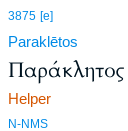
We see that this is Strong word #3875 that is sometimes translated “Helper” and that it’s part of speech is “N-NMS” which means: Noun – Nominative Masculine Singular. I am not a language expert, but can use this to help me understand that the word is a noun that is the subject of the sentence and refers to a single person who is masculine.

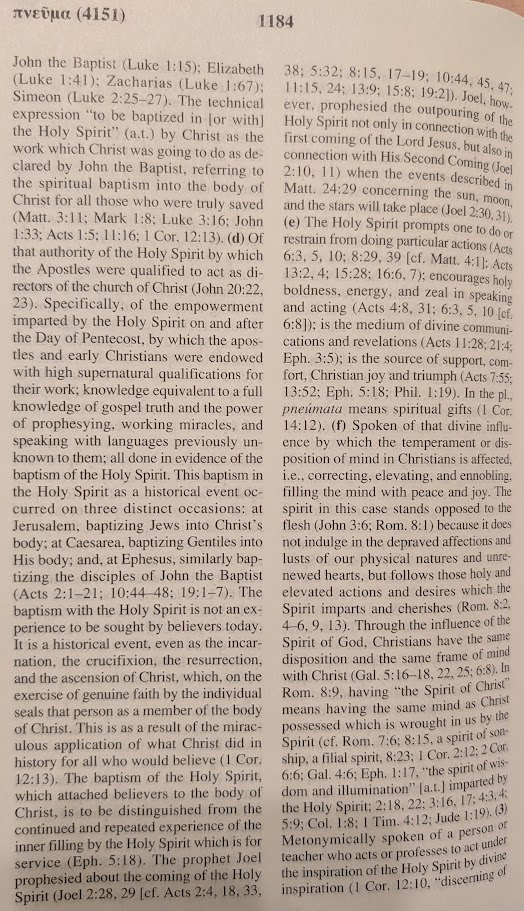
Here we see that “Holy” is “Adj-NNS” an adjective for “Spirit” (N-NNS) singular noun. I will use the 3 relevant pages of the 6 pages from the Word Study New Testament dictionary: for “Spirit” Greek word #4151. Start with (D) at the bottom of the first column:
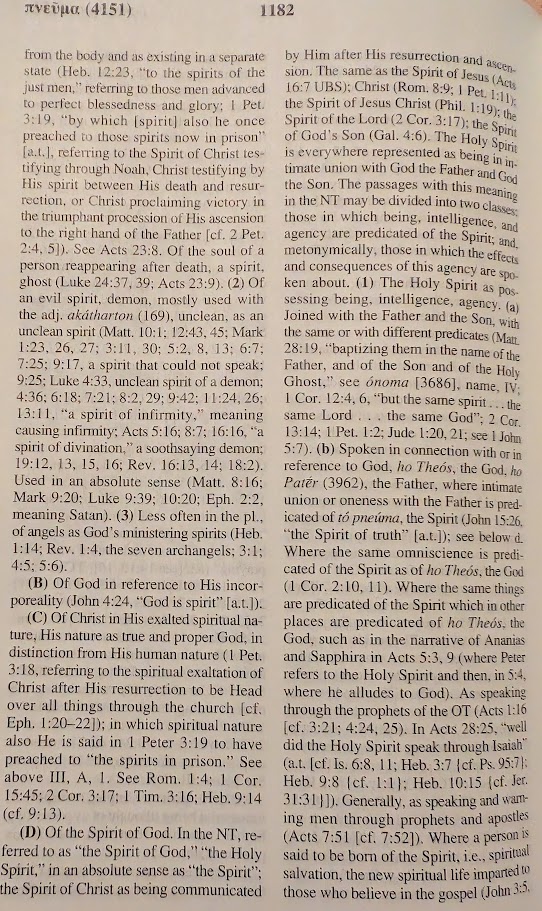
Followed by page 1183:

followed by page 1184:

 God Is In Our Midst

Add your comments or questions (and answers) here: